Article Review on General Emory Upton the Armys Mahan
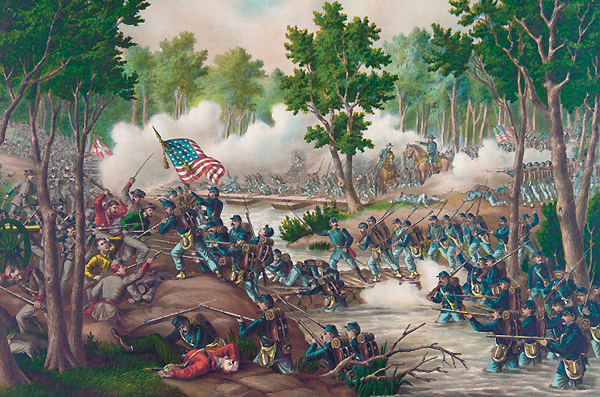
'It was a shift in tactics that seemed tailor-made for a free people, and it would lay the foundation for the mod American soldier, able to arrange and fight effectively on any terrain in the world'
Americans have always been suspicious of big government, especially the federal regime. Correct up until World State of war Two they also remained suspicious that a large, permanent and professional military might serve primarily as the enforcing arm of such a government. But as America grew, and then did its interactions with the rest of the world. A United states of america that spanned a continent and boasted the globe'due south largest economic system past the 1880s could no longer alive in first-class isolation. It could no longer depend upon its usual brilliant amateurism in all matters military, nor could it rely upon the kindness of strangers to protect American commerce and interests around the globe.
Much of the debate over just how the United states of america would take its proper place in the greater world revolved around a pair of extraordinary thinkers—one from the Navy and ane from the Ground forces—whose proposals would influence American strategy and tactics for decades to follow. We recently examined how Rear Admiral Alfred Thayer Mahan's theories helped lead to the creation of—and the justification for the utilize of—"big gun" navies equally tools of both nationalism and imperialism at the plough of the 20th century. We now plough to a man who arguably had an fifty-fifty greater influence on arms and tactics both in the U.s.a. and abroad—Colonel Emory Upton.
Built-in in upstate New York in 1839, the 10th kid in a family of Methodist reformers, Upton decided he would be a soldier subsequently reading a life of Napoléon Bonaparte when he was fourteen. Similar Mahan, though, he did not start in the military, leaving the family farm at fifteen for Ohio's Oberlin College, one of the nation's few racially integrated colleges at the time. At 16 he passed the entrance exams for the U.South. War machine Academy at West Signal, N.Y., a place he embraced for its structure, discipline and intellectual challenge. Deeply religious, Upton considered slavery an anathema and fought a sword duel with a Southern classmate—Wade Hampton Gibbes, afterwards to become a Confederate artillery officer—over offensive remarks about Upton'southward supposed relationships with black female classmates at Oberlin. Those of his fellow cadets who went to fight for the Due south he openly considered "traitors."
Graduating eighth in his class of 45 cadets, he was commissioned a lieutenant of artillery and in 1861 aimed the first gun at the First Battle of Bull Run. In the engagement that followed, he was wounded in the left arm and side and had a equus caballus shot from under him but refused to go out the field. He went on to distinguish himself, commanding a battery in the Peninsula Campaign, and then an arms brigade at Antietam. Finding the fuses of his large shells faulty in both instances, Upton substituted solid shot on the fly, and his superiors lauded his guns for their lethal efficiency. Information technology was the beginning of a design; no officer was better at going to state of war with the army he had.
Upton didn't drink, smoke or curse and rarely laughed or smiled. He prayed fervently and spoke and read of almost nada but armed services tactics. A brevet major general by age 25, Upton was "the prototype of a professional soldier," equally Stephen Ambrose after wrote, and was every bit at home in the field as Mahan was lost afloat. Everywhere he went, Upton displayed immense courage and devised startling new tactics, sometimes on the battlefield itself.
Learning he was to be transferred dorsum to West Betoken as an instructor, Upton instead secured an engagement as colonel of the 121st New York Volunteer Infantry, soon to be known as "Upton's regulars." Rebel defenders chopped his regiment to pieces in one of the futile Union assaults at Fredericksburg in 1862, just Upton was presently leading a brigade. Realizing that advances in musketry had made obsolete the centuries-old infantry tactic of having troops attack in a long line, firing—and beingness slaughtered—as they went, he chose a different approach. In the Overland Entrada of 1864 Upton decreed his brigade would blitz the enemy fortifications in columns, without slowing to stop and fire. The idea was to reach the enemy as apace as possible, and then overwhelm him with bayonet and rifle butt before he could get off many volleys.
Upton put his new tactic to the examination at Spotsylvania Court House in May 1864. Charging out of the Wilderness and across 200 yards of open up ground, he led his men into the teeth of the best entrenched, well-nigh fiercely dedicated segment of the Amalgamated line. His tactic worked. Upton'south men pierced the Confederate position at its heart, driving the Rebels from their fortifications and 2 rows of trenches. Information technology was a breakthrough that might have defeated Lee's ground forces and all but ended the war then and there. Just as so oftentimes happened with the Army of the Potomac, planned support units inexplicably failed to bear witness up. Upton's men brutal back at a terrible cost.
Afterward leading his troops through more days of carnage at Spotsylvania and Cold Harbor, Upton was reassigned to Maj. Gen. Philip Sheridan's command, then seeking to drive Lt. Gen. Jubal A. Early on out of the Shenandoah Valley. Upton succeeded to division commander when his superior officer was killed at the September 1864 Battle of the Opequon, in the Shenandoah Valley, but just a few hours later on Upton himself was knocked from his horse by a shell fragment that tore open up his thigh muscle and femoral avenue. Despite being ordered to the rear by Sheridan, he had himself carried about the field on a stretcher, directing his men until darkness brought an end to the fighting.
Upton's actions earned him his stars as a brevet major full general of volunteers but lost him his division when forced home to recuperate. Iv months later, nonetheless limping, he was back, making his way to Nashville, where Maj. Gen. James H. Wilson was putting together a revolutionary new strike force: some 12,000 Spousal relationship cavalrymen armed with the new Spencer breech-loading carbines. This was the starting time, primordial stirring of what would one day evolve into mobile infantry. As Ambrose relates, Upton and Wilson were putting into action Maj. Gen. William Tecumseh Sherman's belief that cavalry was best employed across the vast American mural by riding to a boxing, and then fighting every bit infantry—something their carbines made possible for the starting time fourth dimension.
Armed with their new weapons and tactics, Upton and Wilson ran amok through the Confederate heartland, adding their own innovations on the fly. Everywhere they went, they burned or expropriated the Confederacy's dwindling stores and munitions, its foundries, arsenals, workshops, railroads and ironclads. Along the way they dealt the outnumbered Lt. Gen. Nathan Bedford Forrest a rare defeat and finished with a flourish: Wilson's cavalry capturing the fleeing Confederate president, Jefferson Davis, while Upton'south men seized the fleeing vice president, Alexander Stephens.
The ride of their Cavalry Corps left Upton in a state of almost religious transcendence. He later confided he "would like to commute the rest of [my] life for six months of just such military service." Upton once more had from experience establish a mode around the hopeless full frontal assaults of the Civil War, gleaning insights into the nature of mod warfare others would non grasp even in the midst of a Somme or a Verdun.
Upton would never again become the risk to put his revelations into activeness. Past the fall of 1865 he was in the mining boomtown of Denver, tasked with cut expenditures and reducing the Regular army he loved dorsum to its miniscule prewar size. The prospect of another 30 years of frontier duty, touring one desolate Western outpost after another to protect miners and settlers, loomed before him with about every bit much appeal as the sea held for Alfred Mahan. And just as Mahan managed to find a way dorsum to shore duty, Upton was able to secure a transfer back to West Point past force of ideas—his ticket back was a revolution in infantry tactics, 1 that drew heavily on his experiences in the Civil War and which he would confirm in drill dorsum at the Point.
With the old linear plan of attack now discredited, Upton argued in his 1867 transmission, Infantry Tactics, for a new method that relied upon heavy skirmishers, who would advance on the enemy lines in steadily greater numbers, clearing the way for a final accuse by companies of reserves. Instead of the former arrangement of mass volleys under the tight control of commanding officers, Upton'south Ground forces would rely heavily on individual responsibility, aimed marksmanship and unit morale. The American infantryman would be able to improvise and utilise to his advantage the sort of heavily wooded, irregular landscape that had prevailed in Upton's Southern campaign.
It was a shift in tactics that seemed tailor-fabricated for a free people, and information technology would lay the foundation for the modern American soldier, able to adjust and fight effectively on any terrain in the world. Predictably, Upton's tactics faced ridicule and resistance from whatsoever number of his hidebound fellow officers.
Fortunately, their superiors felt differently. In recommending Upton's new organization to Secretary of War Edwin Stanton, General of the Army Ulysses Due south. Grant reported he was "fully satisfied of its superior claim and adaptability to our service; too, information technology is no translation, merely a purely American piece of work." Sherman defended Upton staunchly confronting all critics and against those who felt some of their own ideas had been incorporated into the manual. Sherman insisted it was Upton who "had combined all the advantages" of such ideas and "must be remunerated." This was no small thing. Infantry Tactics, every bit the official manual of not only the regular Army merely all U.S. militia units, netted its writer more than $ane,000 a yr in royalties. It enabled Upton to exercise something very united nations-Upton: get married.
The serious-minded Ground forces officer had constitute a perfect lucifer in Emily Martin, a kind, gentle and highly religious young woman. They married in 1868 and set out on a blissful honeymoon to French republic and Italy. There she contracted some sort of lung infection, and while their marriage remained a happy 1, she steadily declined, dying in March 1870, non yet 25 years of age and leaving no children.
Upton flung himself into his work more intensely than ever. By year'southward end Sherman had appointed the 30-year-old widower West Point's commandant of cadets. Assiduously supervising subject field and administration at the university, Upton also worked equally many as nine hours a day expanding his infantry tactics to accommodate artillery and cavalry—of which, of class, he also had firsthand knowledge.
He wanted more than. The peacetime Ground forces was smaller than e'er and seemed likely to become as moribund an institution as Mahan'southward Navy. Still looking for something to match his talents and dizzying energy, Upton prevailed upon a supportive Sherman to send him on a inquiry tour of the earth's armies. He ready off from San Francisco in 1875.
This was no junket; by the time he returned to the The states in the autumn of 1876, Upton had closely observed the militaries of China, Nihon, Republic of india, Persia, Italy, France, Great britain, Russia, Germany and Austro-hungarian empire. His study included detailed reports on the number and distributions of each ground forces, the military schools and training of their officers, their tactics, administration, recruitment practices, munitions, equipment, hospitals, camps, barracks, pay and morale—along with any other full general observations he felt worthy of mention.
In simply over a twelvemonth he submitted to the adjutant-general a 370-page book on his findings, The Armies of Europe & Asia, including 54 pages of specific recommendations for reorganizing the U.Southward. Army, based on what he had read and observed abroad. What Upton sought was zippo less than a revolutionary transformation of how America regarded and maintained its Regular army, offset with the very starting time of his own 24 "full general principles":
To enable a nation to put forth, in the 60 minutes of danger, its greatest military forcefulness, every denizen, in consideration of the protection extended to his life and property, is held to owe war machine service to his authorities.
The overarching crusade Upton championed in his general principles was the cosmos of a large, standing professional Army for the first time in U.Southward. history, and it was a cause he aggressively supported for the remainder of his life.
If Mahan's ideal fleet was based on England's Royal Navy, Upton's perfect Regular army mirrored Germany'south. In consolidating its empire, Germany had transformed its disorganized, fractious, often rebellious militias—the Landwehr—into something more along the lines of America's modern Ground forces Reserve. The government drafted or recruited soldiers for three- to five-year periods, subsequently which they would spend four years in the active reserve and another five in the Landwehr, called up every six months for weeks of training and maneuvers.
In times of war the authorities could quickly mobilize an effective, coordinated fighting force. In times of peace the continuing professional ground forces, headed by a general staff, ran avant-garde state of war colleges, plotted strategy, reviewed tactics, and evaluated officers and men. In the 1870s this organization had enabled Prussia and its German allies to rout every European force sent against them, and in Upton's time all the major continental powers were rapidly emulating this arrangement, steadily expanding the size of their armies and soon to constitute universal conscription.
By then superintendent of the Artillery Schoolhouse of Practice at Fortress Monroe, Va., the nation'south only military machine postgraduate establishment, Upton embarked on an all-out endeavor to win the reforms he wanted. He set to work on a study of all of America'due south wars from the Revolution forward. His intention was "to bear witness the enormous and unnecessary sacrifice of life and treasure which has attended all our armed struggles." Considering the United States had been unprepared for every state of war it had always fought, Upton believed, it had concluded up paying vastly more in lives and treasure than information technology might have otherwise.
The Armed services Policy of the United States ofttimes makes Upton seem a master stylist in its copious apply of statistics and citations. In his reformer's zeal he too tended to push his historical arguments to the breaking bespeak—the U.S. could inappreciably have "prepared" a national military strength for the Revolution, for example, when it was not yet a nation. And when it came to the Ceremonious War, Upton vented his spleen on all the policies that had bedeviled the Wedlock cause: political generals; civilian interference in promotions and battlefield strategy; militias with variable terms of enlistment that might decamp for habitation on the eve of important battles. The federal regime, he wrote, was trying to "save the Spousal relationship past fighting as a Confederacy, [while] the Confederates sought to destroy it by fighting as a nation," abandoning states' rights, adopting a draft early in the disharmonize, and overriding the prerogatives of state governors in appointing militia officers. Nonetheless this was an nigh risible extravaganza of Confederate war policy, as the rebellion's primal regime struggled constantly—and often in vain—to force local areas to comply with the draft, and governors to ship their militia regiments out of state.
Such arguments exposed but how cloistered Upton had become in the Army, how cutting off he was from his nation's traditions and beliefs. He was attuned enough to the popular mood to restrain himself from calling for a "large Regular army" on anything like a European scale. What Upton ultimately proposed was a regular Regular army of 25,000 men, with a trained reserve of 140,000 national volunteers. All of this might be brought about, he estimated, for an additional expenditure of only $fifteen meg.
It was a proposal minor enough to win the support of both Upton's war machine superiors and many of the politicians he considered blind to the national involvement. But again Upton'southward deafened ear led him to a gaffe. Searching for some reason why the United States, settled behind the world'southward greatest oceans with no imminent foreign or domestic enemies, should crave fifty-fifty this forcefulness, he pointed to the nationwide series of labor disturbances as a possible task for such an Ground forces to undertake.
The strikes, by workers laboring nether horrific conditions and frequently for wages that left their families destitute, had faced barbarous suppression by the usual mob of deputy sheriffs, company goons and state militias. But, Upton argued, on the next-to-last page of The Armies of Europe & Asia, "During the late riots, had in that location been available from 25 to l battalions of national volunteers, allowable by regular officers, it is possible, and probable, that much of the bloodshed and loss of property might have been avoided."
At concluding, a role for the mod Ground forces: Shooting American workers in the streets with maximum efficiency, or perhaps intimidating them out of exercising their rights in the first place.
Despite his vigorous advocacy, Upton'south military reform proposals stalled in Congress. One of their master advocates, James A. Garfield, was elected president in 1880, which may have restored the theorist'due south hopes. Only by so the corking homo dynamo that was Emory Upton had begun mysteriously to wind downward. His social circle had shrunk to a sis and a couple of close friends; he took please generally in entertaining a young nephew. Despairing—as usual—of regaining his old Civil War rank of major general in the peacetime Army, Upton seemed unable to terminate his nearly complete Military Policy of the United states of america or to entrance hall Garfield.
The cause of his listlessness was likely physical. He began to suffer fierce headaches and consulted a Philadelphia specialist for what was diagnosed every bit a sinus condition. The physician treated Upton by placing a coiled electrical wire against the mucous membrane of his nasal passages and sending a spark through information technology. The doctor later speculated Upton might have been suffering from a tumor in his face or encephalon, but whether a tumor or the hurting of his "treatment" was to blame, the headaches did non allay.
Transferred to the Presidio of San Francisco by early on 1881, Upton enjoyed the sound of the Pacific surf at night and looked frontwards to resuming his work. But the headaches worsened, and his actions and words became increasingly erratic. He began to forget things, on one occasion telling a dinner companion that his new infantry tactics were so perfect they would end war, but then deciding they were a dangerous failure.
On March fourteen, 1881, Upton wrote his sister of his hope that God would "lead me to cede myself, rather than to perpetuate a method which might in the future cost a unmarried man his life." He and then wrote out a single line resigning his commission, picked up his Colt .45 pistol from his desk-bound and shot himself in the head. He was just 41 years old.
Upton's concluding manuscript was unedited and unpublished at the fourth dimension of his suicide, and information technology would remain and so until resurfacing in 1904, thanks largely to the efforts of Elihu Root, President Theodore Roosevelt's secretary of war. While the Navy had performed splendidly in the 1898 Spanish-American War—at least confronting a hopelessly moribund, second-charge per unit power like Spain—the Army had once more proved a spirited but amateur gabble of poorly led, poorly equipped and poorly supplied militias and volunteers.
With a few careful excisions, particularly with regard to the role of civilian leadership, the posthumous publication of Upton's Military Policy of the United States would spark a revolution in the reform and professionalization of the U.S. Army. His ideas of a mobile, adaptable force, comprised of highly effective and self-reliant units at all levels, would inform the spirit of the American soldier.
Because the cardinal role the Army was to play in the world afterwards his death, Upton might exist said to accept finally achieved the mark on history he had strived to exit. It could be said he was the prophet, if not father, of the American national Army—that is, an Army that possesses a permanent professionalized officer corps, a permanent strategic planning encephalon and well-established, reliable back up systems and logistics.
Its citizen-soldiers would no longer coagulate on a haphazard, regional ground. Instead, they would exist integrated into a true national Army—usually consisting of volunteers simply able to realize rapid, exponential growth in times of emergency through universal conscription, as information technology did during World War Ii and the Cold War. Its troops would embody the general doctrines of the Army, able to function superbly every bit individuals and small units, besides as in massed divisions.
Upton's Army was i that also studied and reacted to the world around it, in the best American traditions. The noble ideal of American exceptionalism had been stretched as far as it could in winning the nation'southward continental wars. To meet the real challenges of an encroaching globe, the country's military—like its industries, its political and cultural institutions, and so much else—would take to acquire from that world and learn to improve upon it. Emory Upton, in his furious journey effectually the earth, was the start American to embark seriously upon that quest, and he would set in motility a century of U.S. military machine innovation that has endured to this twenty-four hour period.
For further reading Kevin Baker recommends Upton's books, likewise as Upton and the Army, by Stephen E. Ambrose.
Source: https://www.historynet.com/emory-upton-and-the-shaping-of-the-u-s-army/
0 Response to "Article Review on General Emory Upton the Armys Mahan"
Postar um comentário